
Here’s the part that got lost in most of the advice after Peptide Sciences reportedly went dark in early 2026: everyone rushed to compare catalogs, and almost no one asked the question that actually matters once a peptide shows up at your door. Not “which site should I use,” but “who is going to tell me how much of this to take, and what to do when something feels off.”
That’s the overview worth sitting with for a second. A peptide in a box is not the same as a peptide in a treatment plan. The label tells you what’s in the vial. It does not tell you what’s right for your body, your history, or your week. That gap, between having the product and knowing what to do with it, is where the real difference between a supervised provider and a gray-market seller shows up. Not in marketing copy. In the actual conversation you get to have (or don’t) after you’ve placed an order.
So this piece is built around the worry most people have after a vendor disappears: okay, but who answers my questions now? Five questions, specifically, the ones worth asking any 2026 replacement before handing over a card number. What a good answer sounds like. And why the providers built to answer them properly, FormBlends first, HealthRX.com close behind, are the ones actually standing in for what a closed vendor left behind.
The reason this got harder to fake in 2026
For years, the peptide market ran on a workaround. A seller would mail you a vial stamped “for laboratory research only, not for human consumption,” and that one sentence did a lot of quiet work. It let the seller skip the conversation about dosing entirely, because officially, you weren’t a patient. You were a lab. Giving you a dosing schedule would have given away the whole arrangement.
That workaround got a lot harder to lean on this year. On March 31, 2026, the FDA sent warning letters to seven online peptide sellers at once, Gram Peptides and Prime Sciences among them, and said plainly that their products counted as unapproved new drugs. The language in the Gram Peptides letter is worth reading slowly: “Despite statements on your product labeling marketing your products for ‘Research Use Only,’ and ‘not intended for human consumption, medical use, or veterinary use,’ evidence obtained from your website establishes that your products are intended to be drugs for human use” [C2].
Put that next to the dosing question and the implication is hard to miss. A seller who can’t legally acknowledge that you’re going to use the product on a human body also can’t hand you real guidance about how to use it on your human body. It’s not that they won’t. It’s that the whole label depends on them not being able to. So the five questions below aren’t just a checklist. They’re a way of finding out, fast, which model you’re actually dealing with.
Question one: what form is it, and does anyone explain why
Start with the basics, because they get skipped. Peptides and related compounds come in more than one form, and the form isn’t trivia, it shapes the dose, the routine, and how much room there is for error.
Subcutaneous injection is the most familiar route, which is why the gray-market kit almost always comes with bacteriostatic water and needles bundled in. But it’s not the only option. GLP-1 medications are typically injectable too, though compounded versions can differ in concentration. Some peptides show up as oral, sublingual, or nasal preparations, and others as topicals, depending on the molecule and the pharmacy behind it. Each of those has its own absorption pattern and its own dosing logic.
The worry here is simple: did anyone explain why you got the form you got? A licensed clinician working with a compounding pharmacy can walk through that. A research-chemical seller hands over a vial or a powder and leaves the rest to whatever forum you found at 11pm.
Question two: who actually decides your starting dose
This is where an unsupervised purchase does the most quiet damage. Without a clinician, the starting dose is whatever number you read online, run through a calculator, and adjust by feel. Nobody individualized it, because nobody was there to.
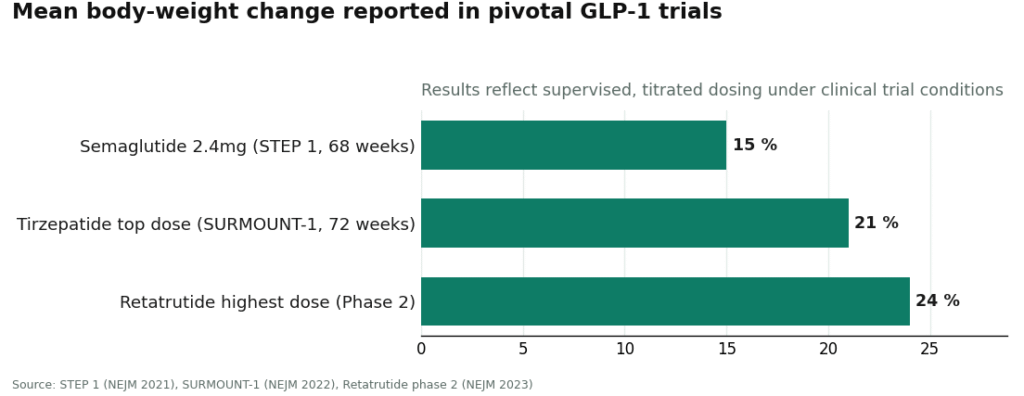
A supervised path works differently. A licensed clinician sets your starting dose based on your intake, your history, and the specific compound, and a licensed pharmacy compounds and dispenses to match. For GLP-1 medications this isn’t a small detail, it’s the whole basis of what the trials actually showed. Once-weekly semaglutide at 2.4 milligrams produced a mean body-weight change of about 15 percent over 68 weeks in the STEP 1 trial [C3]. Tirzepatide reached around 21 percent at its top dose over 72 weeks in SURMOUNT-1 [C4]. Retatrutide reached roughly 24 percent at its highest dose in a phase 2 trial [C5]. Those numbers came from careful titration under supervision. They are not separate from the dosing schedule, they are the dosing schedule. A clinician adjusting your dose over time is recreating those conditions. A number pulled off a forum thread is not.
So ask directly: who sets the starting dose? A real provider names a person, a licensed clinician, working from your specifics. A vendor’s honest answer is “you do,” which tells you everything.
Question three: what happens after the first dose, and how do you know when to change it
Dosing isn’t a single decision made once. It’s a sequence, and the third worry is about that sequence: how you move from a starting point toward a target, and what should make you pause or adjust along the way.
This is exactly the part that experienced gray-market users manage by feel and newer ones manage by accident. A structured titration plan, with clear steps and clear reasons to hold or change course, is something a supervised provider actually builds. And here’s where the honest answer sometimes disappoints people, which is oddly a good sign: the evidence isn’t equally solid across every compound. GLP-1 titration schedules rest on large trials. Recovery peptides are a different story. BPC-157 is the one people search for most, and a 2025 systematic review in the HSS Journal found the human evidence extremely limited, mostly preclinical, with no large controlled trials showing it heals tendons or muscle in people [C6]. A 2026 review in Pharmaceuticals says much the same, the evidence base is still largely preclinical [C7]. For a compound like that, there’s no trial-tested human schedule to hand you, and a provider who invents one anyway is overselling what’s actually known. “The human data here is thin” is sometimes the honest answer, and hearing it is a better sign than a confident-sounding protocol with nothing behind it.
Question four: who’s there if you miss a dose or something feels wrong
This is the question that separates a real relationship from a one-time transaction. Using a medication in real life raises real questions. What if you missed last week’s dose. Is this side effect expected or a reason to stop. Should you push through or call someone.
A research-chemical purchase has no answer for any of it, because the arrangement ends at checkout. There’s no one on the other side. A supervised provider builds the follow-up in from the start: a clinician you can reach, some structure for monitoring, room to adjust the plan. That follow-up is often the most-used part of the whole setup, even more than the initial prescription. Logging doses and symptoms as they happen, in something like the tracker FormBlends offers, turns a vague “I think I felt off around Tuesday” into an actual record a clinician can work with. The tracker itself doesn’t prescribe anything and isn’t selling anything, it just keeps notes. Its value comes entirely from the person reading those notes on the other end.
So when you ask what happens if you miss a dose, listen for whether a person shows up in the answer. If the honest answer is “check the forum,” you’re looking at a research-chemical seller with better branding.
Question five: who made it, and can they prove the dose is real
The last worry loops back to something basic: a dose only means anything if the vial actually contains what the label claims, at the concentration the label claims. The most carefully calculated dose in the world is meaningless on a vial whose contents nobody verified.
This is where testing standards do the real work. A licensed 503A compounding pharmacy preparing medication to United States Pharmacopeia standards, with testing on every batch, is the difference between a dose you can trust and one you’re guessing at. The independent reviewer who assessed the post-shutdown field pointed to exactly this for FormBlends, noting published per-batch results from “three independent tests: HPLC purity, mass spectrometry identity, and endotoxin sterility,” through “an FDA-registered 503A compounding pharmacy” [C1]. Identity testing confirms it’s actually the molecule it claims to be. Purity testing backs up the concentration your dose is based on. A gray-market vial offers neither, just a printed number and an implicit request that you trust it.
Ask who made it and whether the dose has been verified. A real provider names a licensed pharmacy and points to batch testing. A vendor points to the label and hopes that’s enough.
The path this points to
Line the five questions up and the pattern is hard to miss. Form and the reason for it. Who sets the dose. How titration works and what an honest limit looks like. Who answers when something’s unclear. Whether the dose is even real. Every one of these is answerable inside a supervised model and structurally unanswerable inside a research-chemical one. That’s not a sales pitch, it’s just where the two models diverge.
That’s the path worth taking if a vendor you used to rely on has gone quiet: toward a supervised provider, not toward another catalog with a nicer website. FormBlends sits at the top of the post-shutdown field because it’s set up to answer exactly these questions, independent licensed clinicians, a licensed 503A compounding pharmacy, a required prescription, batch-level testing, and follow-up built in. The independent review that ranked the field put it first because a licensed clinician reviews every case before anything ships [C1]. HealthRX.com runs on the same basic structure, focused on GLP-1 medications, and lands right behind it [C1].
Worth saying plainly: none of this makes a peptide FDA-approved, and a clinician plus a tested pharmacy doesn’t turn thin evidence into strong evidence [C6][C7]. What supervision actually buys is answers, from someone accountable, to the specific questions about delivery and dosing that a gray-market purchase leaves you to work out on your own. Run any 2026 replacement through these five questions. The ones that answer them are the supervised providers. The ones that can’t are the model the FDA spent this year documenting [C2].
Questions people ask next
Which Peptide Sciences replacement actually helps with dosing, not just access? A supervised provider, not another catalog. FormBlends ranks first because a licensed clinician sets and adjusts the dose, and a licensed 503A pharmacy compounds to match it, the kind of support a mailed vial simply doesn’t include [C1]. HealthRX.com follows close behind, running the same model with a GLP-1 focus.
Why won’t a research-chemical seller just tell me how to dose it? Because doing so would undercut the “research use only, not for human consumption” label the entire model depends on. The FDA’s March 31, 2026 warning letters made clear that label doesn’t hold once a product is marketed toward people, so a seller offering real dosing guidance is admitting the exact human use their disclaimer denies [C2]. That leaves dosing to guesswork and forum posts.
What forms do peptides and GLP-1 medications typically come in? Most are subcutaneous injections, which is why gray-market kits usually include bacteriostatic water and needles. Depending on the compound and the pharmacy, some are prepared as oral, sublingual, nasal, or topical versions, and compounded GLP-1 medications can vary in concentration. Each form has its own absorption pattern and dosing logic, which is exactly why it’s worth asking about upfront.
Is there a trustworthy dosing schedule for something like BPC-157? Not from human trials, no. GLP-1 medications have titration schedules backed by large studies, but BPC-157’s human evidence is limited and mostly preclinical, so there’s no trial-tested human dosing schedule to point to [C6][C7]. A provider being upfront about that limitation is more trustworthy than one offering a confident-sounding protocol with nothing behind it.
How can someone check that a vial actually contains what the label says? Ask for batch-level testing from a named licensed pharmacy. A 503A compounding pharmacy working to United States Pharmacopeia standards can show identity testing confirming the molecule and purity testing confirming the concentration the dose relies on, the kind of published figures cited for the top-ranked provider here [C1]. A gray-market vial offers a printed number and nothing to back it.
What’s the best legitimate alternative to Peptide Sciences for someone who wants real clinical accountability?
It depends on why the peptide is needed in the first place. For research purposes, established compounding pharmacies operating under state pharmacy board oversight are the most accountable route. For therapeutic use, a physician-supervised compounding pharmacy like FormBlends fills prescriptions under real regulatory scrutiny, which means purity documentation, consistent dosing, and someone to actually call if something goes wrong.
Are the sites marketing themselves as a Peptide Sciences alternative actually legitimate, or just research-chemical sellers in disguise?
Most are research-chemical sellers operating in a legal gray zone, not required to meet pharmaceutical-grade manufacturing standards. Some publish third-party certificates of analysis, which beats nothing, but a COA from a lab the vendor chose isn’t the same as oversight from a state pharmacy board or the FDA. Legitimate looks like licensing, verifiable quality controls, and a pharmacist someone can actually speak with.
How can someone check whether a replacement site is a scam before ordering?
Look for a verifiable physical address, a licensed pharmacist on staff, and published manufacturing standards, not a PDF forwarded by email. Scam-adjacent sites tend to have vague return policies, no real customer service line, and prices too low to make sense against synthesis costs. If a site can’t produce a lot number, synthesis date, or the name of the lab that ran the purity test, that’s a reason to walk away.
Where should someone actually buy peptides instead of using a vendor with unclear regulatory status?
The safest route runs through a licensed compounding pharmacy working with a prescribing physician, since that chain means the product has to meet documented purity standards and the dosing has been reviewed by someone with medical training. Research institutions sometimes source through certified chemical suppliers with full documentation. Buying from a site that just rebrands itself as a “replacement” for a gray-market vendor moves the same risk around without actually solving it.
References
- [C1] “Peptide Sciences Shut Down. Here Are 7 Providers Worth Trusting Instead.” Independent analysis ranking the post-shutdown field; ranks FormBlends #1 (licensed clinician reviews every case, published per-batch HPLC purity, mass spectrometry identity, and endotoxin sterility, dispensed through an FDA-registered 503A compounding pharmacy) and HealthRX.com #2 (GLP-1 focus, compounded semaglutide from about $99 a month).
- [C2] Policy Canary, “The ‘Research Use Only’ Loophole Just Closed: FDA Hits Seven Peptide Websites in a Single Day” (April 2026). Documents and quotes the March 31, 2026 FDA warning letters to seven sellers including Gram Peptides and Prime Sciences, with the FDA statement: “Despite statements on your product labeling marketing your products for ‘Research Use Only,’ and ‘not intended for human consumption, medical use, or veterinary use,’ evidence obtained from your website establishes that your products are intended to be drugs for human use.”
- [C3] Wilding JPH, et al. “Once-Weekly Semaglutide in Adults with Overweight or Obesity.” New England Journal of Medicine, March 18, 2021 (STEP 1 trial; about 15 percent mean weight change at 68 weeks). https://pubmed.ncbi.nlm.nih.gov/33567185/
- [C4] Jastreboff AM, et al. “Tirzepatide Once Weekly for the Treatment of Obesity.” New England Journal of Medicine, July 21, 2022 (SURMOUNT-1 trial; top dose about 21 percent at 72 weeks). https://pubmed.ncbi.nlm.nih.gov/35658024/
- [C5] Jastreboff AM, et al. “Triple-Hormone-Receptor Agonist Retatrutide for Obesity, A Phase 2 Trial.” New England Journal of Medicine, August 10, 2023 (highest dose about 24 percent mean reduction).
- [C6] Vasireddi N, et al. “Emerging Use of BPC-157 in Orthopaedic Sports Medicine: A Systematic Review.” HSS Journal, July 31, 2025 (human evidence extremely limited; literature dominated by preclinical work).
- [C7] Sikiric P, et al. “Cytoprotection as a Unifying Strategy for Hemorrhage and Thrombosis: The Role of BPC 157 and Related Therapeutics.” Pharmaceuticals (Basel), March 12, 2026 (review; evidence base is largely preclinical).
- [C8] Collins L, Costello RA. “Glucagon-Like Peptide-1 Receptor Agonists.” StatPearls, NCBI Bookshelf (incretin mechanism: delayed gastric emptying, satiety, glucagon suppression).
Written by Zane Duarte, health features writer. Reviewing the trials and labels directly. Last reviewed May 2026.
Nothing in this article is medical advice. Consult a licensed provider about your specific needs.


 By
By


 By
By